My cameraman : Cyril Sauvenière
I told the story. He showed it.
On television, people only remember the one who speaks. In Rome, the man carrying the camera was Cyril Sauvenière. He went everywhere with me.
Claude Brovelli
The one you never see
A television news report is never made alone. There is the one holding the microphone and the one carrying the camera. The first signs the report: people know his face, his voice, his name comes up on screen. The second is never seen. He is behind the lens. Yet he is the one who decides what you look at.
In Rome, the TF1 crew was Cyril on camera, Enzo Lamanna on sound, and me on the microphone. The Red Brigades, the year of three popes, a President of the French Republic received at the Vatican: I told the story, he showed it.
The news bulletins of the day almost never said who was holding the camera. In the archives that can still be watched today, his name appears on screen only twice, on 10 August and 26 October 1978. The rest of the time, he exists only through his pictures.
The wrong side of the camera
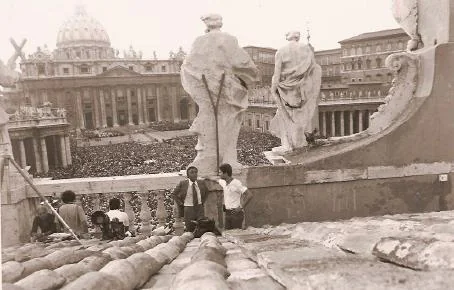
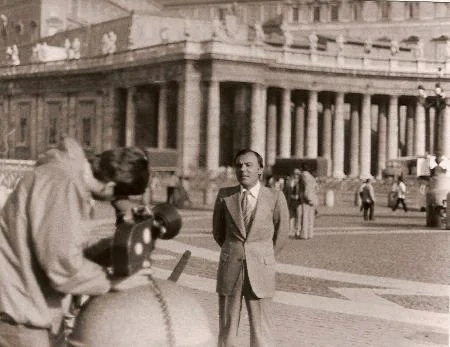
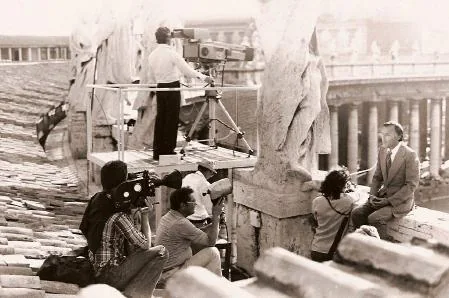
There are very few photographs of a cameraman at work, and for good reason: he is always on the wrong side of the camera. In my albums I am the one you see, in a suit, microphone in hand. But look closely. In the foreground, from behind, there is sometimes a shoulder, a viewfinder, a camera. That is the cameraman's place: the one from which you see everything without being seen.
On 16 March 1978, four hours after the shooting on Via Fani, our pictures were on air in the one o'clock news.
People say a journalist "covered" an event. The word is too big for one man. We were a crew, and he was the one who brought back the proof. I owed him this page.
Credits
Twice, his name on screen
In 1978, news reports rarely displayed their credits. Twice, Cyril's name went out on TF1's eight o'clock news. It can still be read on the website of the French National Audiovisual Institute.
Images : C. SAUVENIERE
Son : J. GREGOIRE
Montage: J. GERMAN
10 August 1978
Before the conclave
Four days after the death of Paul VI, two days before his funeral. The cardinals arrive in Rome for the conclave, mobbed by microphones and cameras.
See the credits on the INA website · At 1 min 03Reportage :
Claude BROVELLI -TF.1 ROME-
Cyril SAUVENIERE
Son : Enzo LAMANNA
26 October 1978
The president at the Vatican
John Paul II receives Valéry Giscard d'Estaing, the first head of state received by the new pope, the bulletin announces. The motorcade enters the Courtyard of St Damasus between the Swiss Guards. Our two names appear one under the other.
See the credits on the INA website · At 1 min 03Credits reset in type from the reports preserved by the INA.
Behind the scenes
For once, the camera is in the shot
Two photographs from my albums, taken in 1978. In each one, look at the foreground.
The craft
A news report, in 1978
To appreciate what a cameraman did, you have to remember how a television news report was made at the time.
- 01
A TF1 reporting crew in the late 1970s: a journalist, a cameraman, a sound recordist and a lighting assistant.
- 02
Footage is shot on 16 mm colour reversal film. Sound is recorded separately on magnetic tape, and everything comes together in the edit.
- 03
In Rome, in 1978, the credits also name the sound recordist, Enzo Lamanna or J. Grégoire, and the editor, J. German.
- 04
The Vatican has no television of its own yet: the ceremonies are filmed by RAI cameras, eight of them for the funeral of Paul VI. The Vatican Television Centre will not be founded until 1983.
- 05
Live links with Paris go through the RAI. On 17 October 1978, the day after John Paul II's election, the link is late: the RAI is swamped with requests.
- 06
Lightweight video cameras only reach France in 1978 and 1979, first in the regional stations of FR3.
- 07
At TF1, news cameramen are journalists: in 1982 Le Monde writes of the channel's "journalist cameramen".
Road log
Where we stood
1978, the year everything happened: the Moro affair, then three popes in seventy-one days. Date by date, as the French National Audiovisual Institute preserves it. The days on which his name is written in black and white are marked.
1978
18 February 1978
A Honda at Vallelunga
His name: INA credits
Before the Red Brigades and the conclaves, some mechanics: for the motoring programme "Auto Moto", Cyril signs a test of a six-cylinder Honda 1000 on the Vallelunga circuit, near Rome. Three minutes forty-five, on a Saturday at 6.44 pm. It is the earliest trace of him in Rome in the television archives.
Read the INA catalogue entry16 March 1978
The kidnapping of Aldo Moro
His name: my own caption
That morning, shortly after nine, the Red Brigades kidnap Aldo Moro and shoot dead the five men of his escort. We film from a balcony above the crossroads: the bullet-riddled cars, the white sheets, the carabinieri. Four hours later our pictures go out on the one o'clock news. You can see me, TF1 microphone in hand. You cannot see Cyril: he is filming. The pictures of Via Fani that day are his.
Watch the archive on the INA website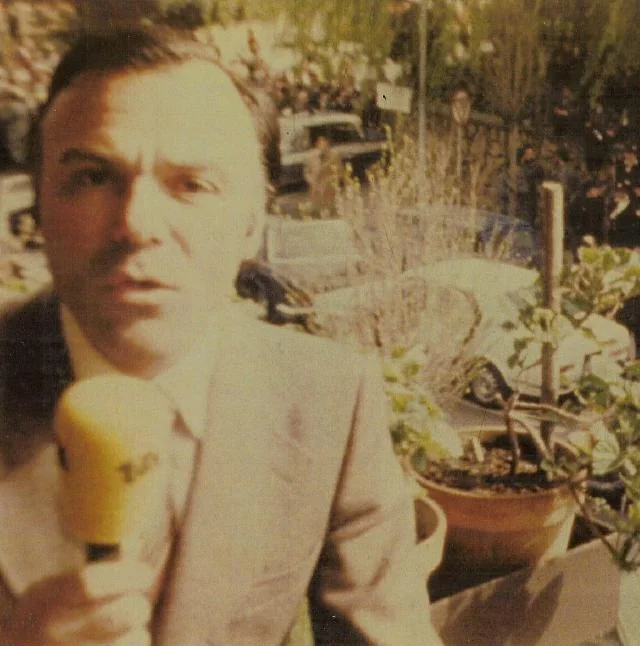
Via Fani, 16 March 1978. Filmed by Cyril Sauvenière.Archives personnelles de Claude Brovelli March to May 1978
Fifty-five days
The kidnappers' communiqués, the prisoner's letters, a country torn between firmness and negotiation. On 3 May, in front of our camera, Bettino Craxi says he is looking for "a humanitarian solution". Six days later Aldo Moro's body is found in the boot of a car on Via Caetani.
Watch the archive on the INA websiteAugust 1978
On the rooftops, at the death of Paul VI
His name: my caption, then the eight o'clock credits
Paul VI dies on 6 August at Castel Gandolfo. The television crews set up on the roof of Bernini's colonnade, among the statues, above a square black with people. Inside the basilica, camera lights are now allowed only ten seconds an hour. It was on those rooftops that the photograph opening this page was taken: Cyril and I, the crowd at our feet. On 10 August, on the eight o'clock news, his name comes up on screen.
Watch the archive on the INA website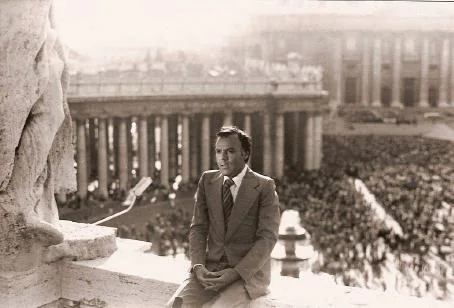
On the Vatican rooftops, August 1978Archives personnelles de Claude Brovelli 26 August 1978
The smoke over the Vatican
Five times the conclave chimney sends up smoke whose colour nobody can call. In the evening the Patriarch of Venice appears on the balcony: John Paul I. I comment live on his first appearance, then we stay in the square for the late edition.
Watch the archive on the INA website16 October 1978
It all begins again
Thirty-three days after his election the smiling pope is dead. We climb back onto the rooftops. On 16 October, at 6.19 pm, the smoke is white beyond dispute: Karol Wojtyla, a Pole. He is the third pope in seventy-one days.
Watch the archive on the INA website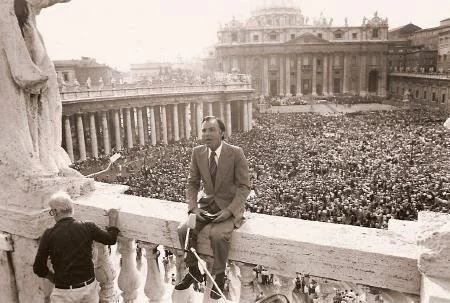
On the Vatican rooftops, late September 1978, at the death of John Paul IArchives personnelles de Claude Brovelli 26 October 1978
Both our names on screen
His name: eight o'clock news credits
Ten days after his election, John Paul II receives Valéry Giscard d'Estaing. The Swiss Guards, the red carpet, the president's car driving into the courtyard. That evening, on the eight o'clock news, the report's credits show my name, then Cyril's, then that of Enzo Lamanna, on sound.
Watch the archive on the INA website18 and 19 November 1978
Archbishop Lefebvre will not answer
His name: Paris Match
On a Saturday afternoon, when everything at the Vatican is closed, John Paul II receives Archbishop Lefebvre, the bishop at odds with Rome. Nobody expected it. His convoy leaves the seminary in Albano under police escort, and we set off after it. Stopped at a motorway toll, he smiles but refuses to answer my questions. Paris Match will tell the story and name us both: Cyril and me.
Read the INA catalogue entry
What came next
The years that followed
After 1978 the archives no longer say who was holding the camera: the bulletins did not print it. Here, date by date, is where TF1's Rome bureau went next, all the way round the world in the wake of John Paul II.
1979
1 February 1979
"You are asking me to be a prophet"
The new pope's first journey: Mexico, vast crowds, mariachis playing as he passes. On the flight home he comes to talk to the journalists. I hold out the TF1 microphone and ask him about the future of his pontificate. "You are asking me to be a prophet," he replies.
Read the INA catalogue entry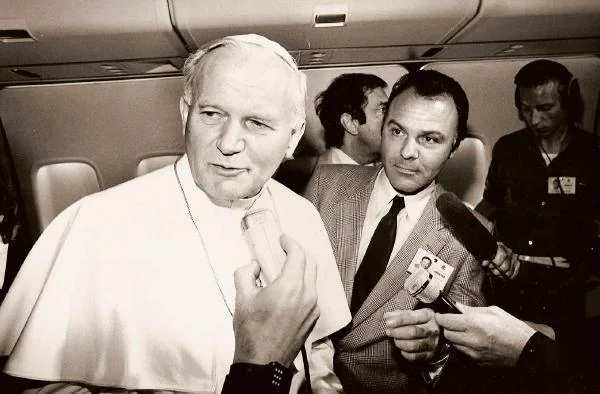
Aboard the papal plane, the TF1 microphone held out to John Paul IIArchives personnelles de Claude Brovelli 24 April 1979
The one o'clock news at the president's
Yves Mourousi anchors his news programme live from the gardens of the presidential palace. With him, I interview Sandro Pertini, the old Resistance fighter who has become President of the Republic.
Read the INA catalogue entryAugust to October 1979
Living on Etna
The volcano has woken: lava flows, roads cut, Catania under black dust. In September an explosion kills tourists near the crater. We go back for the magazine programme "L'événement": eleven and a half minutes with the scientists camped at the edge of the volcano.
Read the INA catalogue entry28 November 1979
The pope in Turkey
An almost cold welcome in Ankara. John Paul II pays his respects at Atatürk's tomb, then goes on to Istanbul: Topkapi, Hagia Sophia, the meeting with Patriarch Dimitrios I. On the plane out he had talked to me about Iran and the risk of a holy war.
Read the INA catalogue entry
1980
19 February 1980
The carnival comes back to life
Six minutes for six days of festivities, costumed processions and gondolas, for Yves Mourousi's one o'clock news: the Venice carnival comes back to life.
Watch the archive on the INA website2 to 12 May 1980
With the pope in Africa
John Paul II's first African journey. Drums as he steps off the plane, the motorcade through the streets of Kinshasa, the Congo river, then Nairobi, Accra, Abidjan. TF1 deposited with the INA the raw footage shot by its own crew on this journey. My albums keep a sheet of frames from it: there I am, microphone in hand, in front of the camera.
Read the INA catalogue entry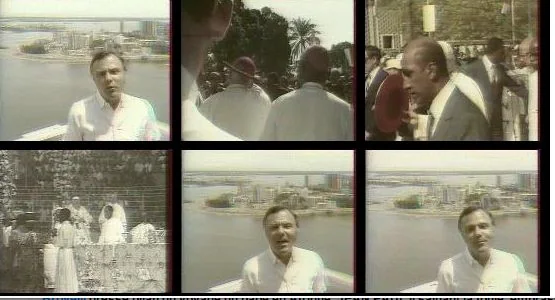
With John Paul II in Zaire, May 1980Archives personnelles de Claude Brovelli 30 June to 12 July 1980
Twelve days in Brazil
Belo Horizonte, Brasilia, a favela in Rio, the great Mass in the stadium, Porto Alegre, Salvador da Bahia, the embrace with Dom Helder Camara. Everywhere, a human tide. On the plane I ask the pope how hard this journey has been.
Read the INA catalogue entry23 November to 23 December 1980
The earth shook
On a Sunday evening the earth shakes south of Naples. Whole villages are flattened. Over a month we send nineteen reports: rescuers in the rubble, rows of coffins, families around camp fires, then snow on the makeshift camps. In a ruined village, a mask over my face, I salvage crockery from a gutted house and pass it out through the window.
Read the INA catalogue entry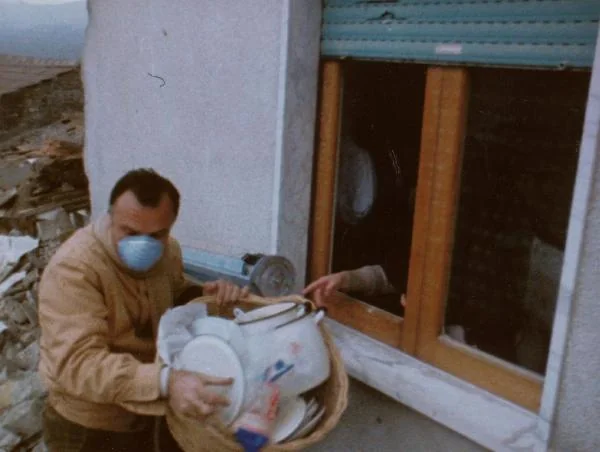
In a ruined village in Irpinia, November 1980Archives personnelles de Claude Brovelli 31 December 1980
Walking with Pertini
The Italian president is spending the holidays in Nice, the city of his exile under Fascism. I interview him as I walk beside him in the street, five bodyguards behind us, while the Red Brigades are holding Judge D'Urso. "I am for firmness," he says.
Read the INA catalogue entry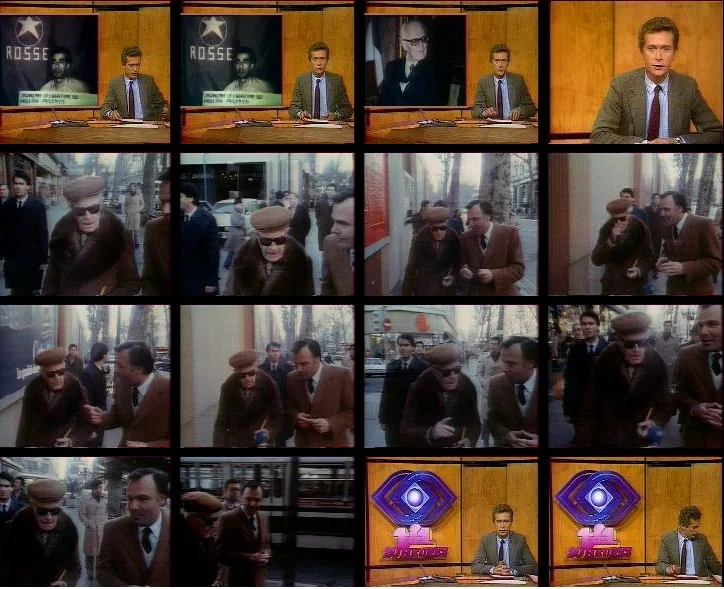
With President Pertini in the streets of NiceArchives personnelles de Claude Brovelli
His story
From the viewfinder to the microphone
My cameraman did more than carry the camera. This is what the television archives say about him.
Cyril did not wait for Rome to start making pictures. In 1969 he was at the ORTF, in the crew of a report for the programme "Contact". In 1972 he co-directed a report for "La France défigurée" in Fréjus, on a Roman aqueduct threatened by a rubbish tip. Romans, already. Both programmes were born in the house where I was working at the time, around Michel Péricard: we were under the same roof long before Rome.
In Rome he shot my reports and sometimes signed his own. In February 1978, a month before Via Fani, the motoring programme "Auto Moto" broadcast his test of a six-cylinder Honda on the Vallelunga circuit, near Rome.
Then he crossed to the other side of the camera. On 18 June 1982 the TF1 news credited him as a journalist for the first time, on Lebanon at war. Then came Poland, Iran, Belfast for "Sept sur sept", Yasser Arafat in Tunis. In 1985 he went to Cambodia for "Infovision": thirteen minutes on Phnom Penh, billed in Le Monde under the names of Cyril Sauvenière and Philippe Decaux. This time he was the one holding the microphone.
In October 1985, after Alain Chaillou, who had succeeded me, he went back to Rome, this time as correspondent. In August 1986 the football show "Téléfoot" introduced him as TF1's correspondent in Rome. The Achille Lauro, the election of President Cossiga, the great Mafia trial in Palermo, which he reported facing the camera outside the courthouse, Judge Falcone for "Sept sur sept", Maradona's Naples: he was now the one telling the French about Italy. A few years after I left, the TF1 microphone in Rome was held by my cameraman.
Two dates sum up this story. On 9 June 1985 the eight o'clock news ran his report on Italy, then mine, on Togo: one after the other, like old times. And on 20 November 1986, when a film about the Moro affair caused a row, he was the one who told the French about it, over the footage of 16 March 1978.
On 1 September 1987 he filed his last report from Rome: a mutiny at Porto Azzurro prison, on the island of Elba. That same year, after privatisation, I left TF1. He stayed: from January 1988 he was back on the foreign desk, covering Argentina, Afghanistan, Tiananmen in 1989, the Cambodia of the Khmer Rouge, Greece. His last signed report dates from June 1994. His name then appears right at the top of the credits of TF1's eight o'clock news: as editor-in-chief, then as programme editor, alongside the anchors Jean-Claude Narcy, Claire Chazal and Patrick Poivre d'Arvor, until 2001. The French National Audiovisual Institute holds more than four hundred and fifty reports signed with his name.
1967
Army photographer
The archives of the ECPAD, the French defence image agency, hold photographic reports from May 1967 credited to "Sauvenière, Cyril".
1969
"Contact" (ORTF)
In the crew of a report on army selection days at Vincennes, broadcast on 13 June.
1972
"La France défigurée" (ORTF)
Co-director of a report on the Roman aqueduct in Fréjus, broadcast on 10 December.
Watch his report on the INA website1978
Rome, with me
"Auto Moto" in February, Via Fani in March, the Vatican rooftops in August, his name in the eight o'clock credits on 10 August and 26 October, Archbishop Lefebvre in November.
1982
Journalist on TF1's foreign desk
First signed report on 18 June: Lebanon. Then Poland, Iran, Turkey.
Read the INA catalogue entry1983
On assignment in Italy
The Communist Party congress in Milan in March, the general election in June, an interview with Bettino Craxi in August.
1984
"Sept sur sept" (TF1)
"Living in Belfast", six minutes in Northern Ireland, on 22 April.
1985
Arafat, then Cambodia
The interview with Yasser Arafat in Tunis for "Sept sur sept" in March, then "Phnom Penh: the Vietnamese peace", thirteen minutes for "Infovision" in November.
Read the INA catalogue entry1985-1987
TF1 correspondent in Rome
From October 1985 to September 1987, after Alain Chaillou: the Achille Lauro, the election of Francesco Cossiga, the Palermo trial, the Marcinkus affair, Naples as Italian champions. Last report from Rome on 1 September 1987, on the island of Elba.
1986
Judge Falcone
"Judge Giovanni Falcone speaks", four minutes forty for "Sept sur sept", on 16 February.
Read the INA catalogue entry1986
"Vacances Rambo"
His report from a survival school in the Dolomites, for TF1, broadcast on 8 November.
Watch his report on the INA website1988-1994
Back on the foreign desk
Argentina, Afghanistan, the Tiananmen crackdown, an interview with Khieu Samphan, the 1989 European elections live from Athens. Last signed report on 24 June 1994.
1996-2001
TF1's eight o'clock news
As editor-in-chief, then programme editor of the bulletins anchored by Claire Chazal and Patrick Poivre d'Arvor, until 17 March 2001.
Online archives
His pictures, today
A few of his reports can still be watched freely on the website of the French National Audiovisual Institute.
- 10 December 1972Fréjus: a Roman aqueduct under threat"La France défigurée", ORTF. He co-directed it.Watch on the INA website
- 16 March 1978The kidnapping of Aldo MoroTF1 eight o'clock news. The pictures of Via Fani are his.Watch on the INA website
- 10 August 1978Before the conclaveTF1 eight o'clock news. His name on screen, at 1 min 03.Watch on the INA website
- 26 October 1978Valéry Giscard d'Estaing at the VaticanTF1 eight o'clock news. Both our names on screen, at 1 min 03.Watch on the INA website
- 8 November 1986Rambo holidaysTF1. His report from a survival school in the Dolomites.Watch on the INA website
In Rome I was the one you saw on screen. He held the camera. Without him you would have seen nothing.
Thank you, Cyril.
Claude Brovelli