Chapter 4. Every evening, in France's living rooms
In the autumn of 1969, a war reporter nobody had ever seen became a familiar face. From the second channel, the only one in colour, to the birth of TF1, I read the news in the days when an entire country sat down in front of the same screen. Eight years of live television, presidential journeys and history in the making.
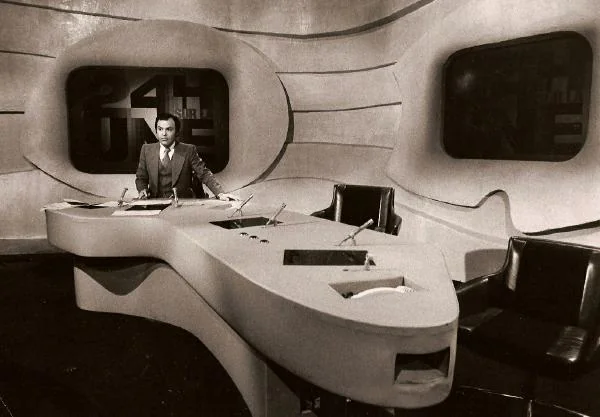
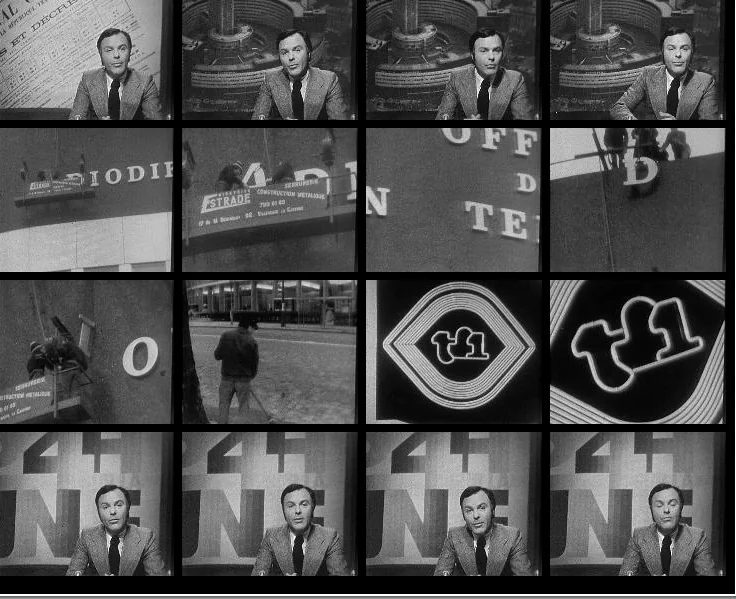
On the screen, workmen are taking down the ORTF sign from the Maison de la Radio. It is one o'clock on Saturday 4 January 1975, and it falls to me to explain to viewers of the first channel what they are watching: in two days' time the ORTF, France's state broadcaster, will have ceased to exist. It is being broken up into seven companies. I show the audience a brand-new logo: TF1.
To understand what I was doing there that day, we have to go back five years.
A woman, and a channel in colour
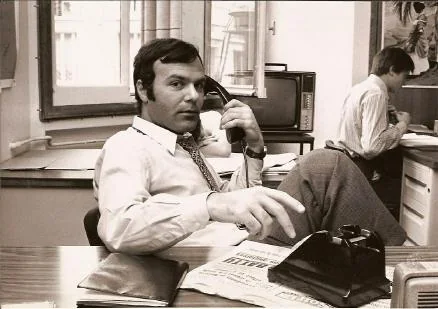
A wire reporter has no face. For eight years my AFP dispatches had travelled from paper to paper without anyone knowing what their author looked like. In 1969 I left the agency for France Inter, where I analysed world affairs for Inter-Actualités, the newsroom run by Jacqueline Baudrier. That woman was about to change my life.
That same year Jacques Chaban-Delmas's government abolished the Ministry of Information and set up two rival newsrooms inside the ORTF: Pierre Desgraupes on the first channel, Jacqueline Baudrier on the second. She built her team from scratch and took a core of radio reporters with her. In September 1969 I was one of them. The star names were Léon Zitrone and Michel Péricard; around them came a generation of newcomers: Jean-François Robinet, Bernard Volker, Jacques Alexandre, and me.
Our programme was called "24 heures sur la Deux" and went on air that autumn. The second channel had one privilege: it was the only one broadcasting in colour. A photograph dated 26 February 1970 shows me on that set with Léon Zitrone. Eighteen months earlier I had been on the Biafran front.
The reporter behind the newsreader
You have to picture France as it was then. Two channels, then three from the last day of 1972. No video recorders, no rolling news, no Internet. In the evening the country sat down in front of the set, often as a family, and watched the same bulletin. Whoever read it walked into the dining rooms of an entire nation. It is a responsibility. It is also a trap: never leaving the studio again.
I did not let it close on me. My earliest reports held by the INA look like my previous life: in November 1969, the My Lai massacre, which the American press had just brought to light; on 22 January 1970, a week after the civil war ended, the programme's first report from the Biafra region, filmed with Christian Bousquet: a refugee camp, a hospital.
Then the encounters came thick and fast. In April 1970 I interviewed the Swedish prime minister, Olof Palme. On 2 June Nicolae Ceausescu granted Claude Manuel and me a filmed interview as a prelude to his visit to France; both channels broadcast it on the 15th. In January 1971, in Senegal, I interviewed President Léopold Sédar Senghor.
In October 1971 I made a two-part investigation, "Le fascisme italien". The MSI, the neo-fascist party, had just made an electoral breakthrough; in Sicily it had taken close to a third of the vote. There I met its leader, Giorgio Almirante, who proclaimed his loyalty to Mussolini while declining the title of heir. My father had been forced to flee Fascist Italy in the 1930s. His son was going back with a camera.
From the second channel to the first
In the summer of 1972 the ORTF was reorganised. Pierre Desgraupes's team left the first channel and ours moved in: on 11 September 1972 our programme became "24 heures sur la Une", in the rue Cognacq-Jay. Three bulletins a day: one o'clock, a quarter to eight and the late edition. I was in charge of the midday edition, with the rank of deputy editor-in-chief. Seven of us took turns in the chair, from Léon Zitrone to Jean-Pierre Berthet. One irony of technology: in changing channels we traded colour for black and white.
The INA holds one hundred and thirty-one bulletins that I presented between 14 September 1972 and 4 January 1975, mostly at one o'clock to begin with and then, in 1974, more and more often in the evening. That year L'Express, comparing the two channels' news, set two names side by side: mine on the first, Jean-Marie Cavada's on the second.
Pompidou, from Lomé to Notre-Dame
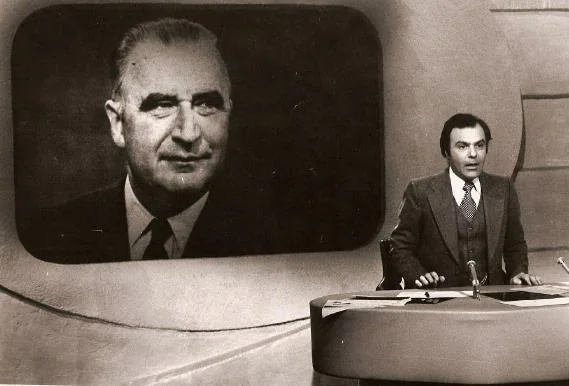
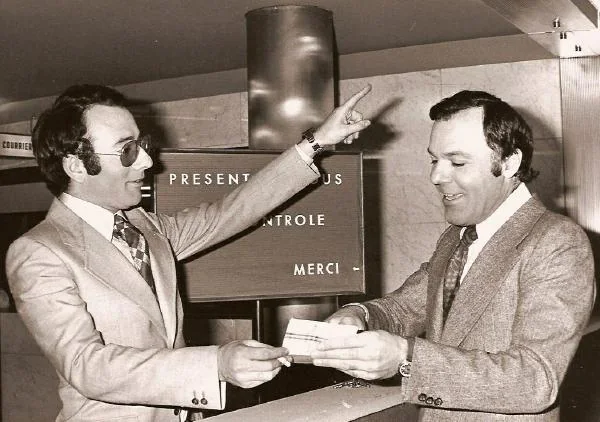
None of this kept me behind the desk. In November 1972 I was the programme's special correspondent on Georges Pompidou's journey through West Africa. In Lomé, on 24 November, the President of the Republic gave me an eight-minute interview to sum up his tour. I admired the man.
On 2 April 1974 Georges Pompidou died. On the 4th I presented the evening news devoted to the succession; on the 6th, a day of national mourning, I was on air for the ceremony at Notre-Dame. On 24 May I opened on the new president, Valéry Giscard d'Estaing, and the same bulletin announced the death of Duke Ellington. On 10 August I introduced a special report on the drought in the Sahel, filmed in Senegal, which had been my first posting abroad.
The night the ORTF went dark
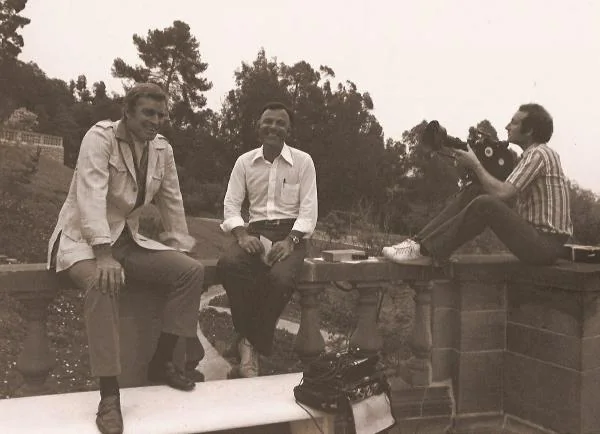
The law of 7 August 1974 had sealed the Office's fate. On 20 December Le Monde published the formula of Henri Marque, who was to run the first channel's news: three bulletins, three people in charge. Yves Mourousi at one o'clock, Roger Gicquel at eight, and me at the end of the evening. On 4 January 1975, the day of the dismantled sign, I presented both the one o'clock and the eight o'clock news. The next day, Sunday 5 January, I lived through the ORTF's last evening from the inside. During the night the Office gave way to seven companies, among them TF1, Antenne 2, FR3 and the INA.
On Monday 6 January 1975 the first channel was called TF1, and that first evening's listings had me down for half past ten. Mine was IT1 Nuit, the last edition: the day in summary for the night owls, when the house has gone quiet and people listen more closely.
Playing myself, then Hollywood
Fame shows itself in odd ways. In 1976 the TF1 series "Nick Verlaine ou Comment voler la tour Eiffel" cast me as the television newsreader, in effect as myself. In 1978 I was the journalist conducting the interview in "Vas-y maman", Nicole de Buron's film starring Annie Girardot. In 1982 a novel, "Parisgrad", had the television in its plot announce my name.
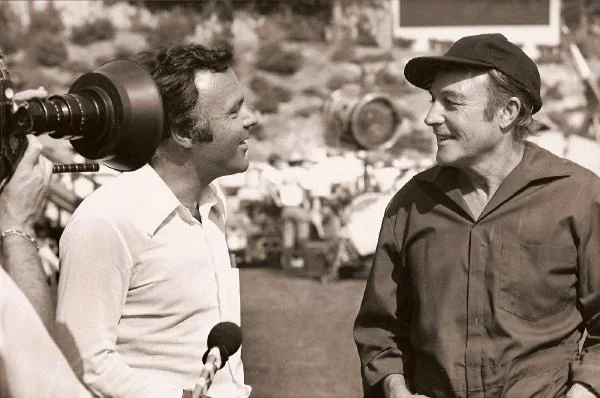
In 1976 I headed TF1's arts desk, and set off for Hollywood to shoot a summer series for the eight o'clock news. On 13 August Linda Blair, the possessed child of The Exorcist, answered my questions while out jogging. On the 14th, Gene Kelly, on a set he shared with the stuntman Evel Knievel. On the 16th, Charlton Heston, talking about Midway. I also met Paul Newman, Sydney Pollack and Ursula Andress.
Television had better still in store. In 1977 TF1 offered me a posting abroad: permanent correspondent in Rome. Rome, which meant Italy, the country my father had fled forty years earlier. I did not speak a word of Italian. I went anyway.